
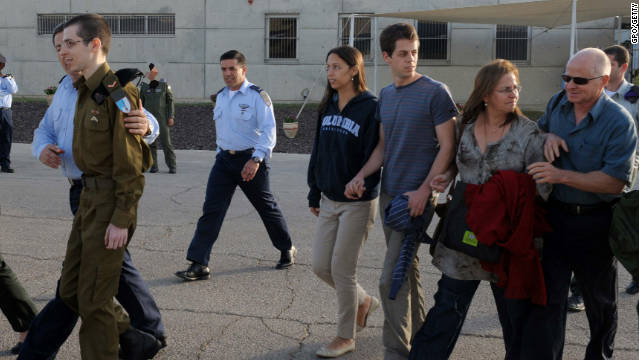
Looking pale, thin and emotional, Gilad Shalit was reunited with his family Tuesday after more than five years in captivity. Now he faces what is likely to be a bewildering few days, weeks and months as he readjusts to a life of liberty.
While no one yet knows exactly what he went through, other captives' experiences give an insight into his likely state of mind -- and suggest that although he has his freedom, other challenges lie ahead.
Only 19 at the time of his capture in June 2006, Shalit was known to few outside his circle of family, friends and fellow soldiers.
But after years spent in virtual isolation, he has been thrust into the limelight and faces a barrage of media attention.
Speaking to Egyptian television shortly after his release, Shalit said he had missed his family and friends. "I missed interacting with normal people," he told the interviewer.
A few details emerged later as his father, Noam Shalit, addressed the throng of reporters gathered outside the family's home in northern Israel.
His son felt good, he said, but was suffering the effects of small shrapnel wounds received long ago but never properly treated, as well as a lack of sunlight.
While Gilad was very happy to be home, it was difficult for him to be exposed to so many people after so long in isolation, unable to speak to anyone in his own language, Noam Shalit said.
"He basically came out of a dark hole, a dark basement, and came out of that to this great crowd," he said, adding that it must have been amazing for his son to see such a show of support from their village and the country.
The family had greeted Gilad with big hugs, he said, but so far they had had little chance to do more than eat together in what had been an exhausting day.
"He said in the beginning the conditions were difficult and he wasn't particularly well treated, but more recently things improved," he said of his son, adding that he was sure the family would learn more over time.
David Senesh, an Israeli clinical psychologist and former prisoner of war based near Tel Aviv, told CNN that Shalit may continue to feel isolated despite being back among loved ones.

ليست هناك تعليقات:
إرسال تعليق