
Violence remains a problem in neighboring Iraq, as well as Afghanistan. Iran, a longtime rival of the Saudi royal family's, is still at odds with much of the international community over its nuclear program, among other issues.
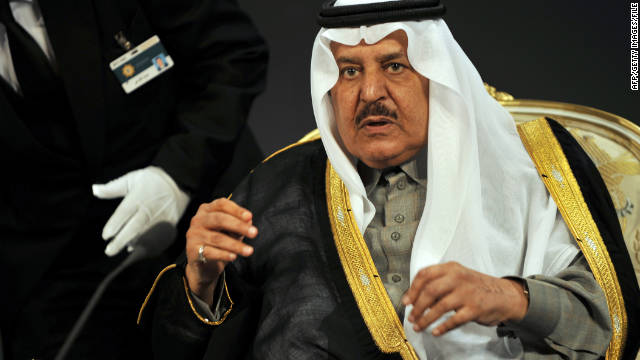
Before the announcement, Nayef had been considered a likely successor to his brother as crown prince. He was named in 2009 as second deputy prime minister, a post held by the second in line to the throne.
Nayef has served as the Saudi interior minister since 1975, having overseen the kingdom's counterterrorism efforts.
Saudi Arabia is one of the only countries that has truly dismantled a domestic al Qaeda network, said Christopher Boucek, a Saudi expert at the Carnegie Endowment for International Peace.
"Nayef is widely seen as a hard-line conservative who, at best, is lukewarm to King Abdullah's reform initiatives," read a classified U.S. Embassy cable leaked by the website WikiLeaks.
In addition to his new title, Nayef will remain interior minister, according to Friday's announcement. The Saudi Press Agency noted that he also has been appointed deputy premier, meaning he will officially hold three positions in the Saudi government.
He and others met Thursday with a U.S. delegation that included Vice President Joe Biden, CIA Director David Petraeus and Sen. John McCain.
Ascension to the Saudi throne is kept within the royal family, though it does not pass from father to son. Instead, it's a complex process, and decisions in the conservative kingdom are often cloaked in secrecy.
Nayef's appointment follows the first-ever convening of the Allegiance Council, which the king established in 2006 to discuss and allow for more transparency on succession issues.
The king made his decision after receiving their input. Afterward, Abdullah instructed Nayef's fellow princes to pledge allegiance to him as the new crown prince.

ليست هناك تعليقات:
إرسال تعليق