
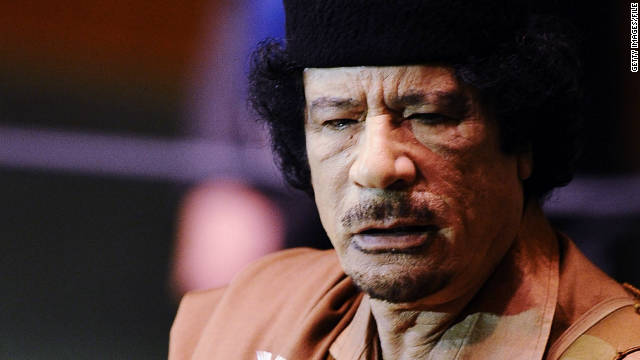
Over four decades in power in Libya, Moammar Gadhafi portrayed himself as a revolutionary battling Western colonialism, the leader of a united Africa and the "king of kings" of his oil-rich desert nation.
He died a fugitive in his hometown, hunted down Thursday by the forces that toppled his iron-fisted rule two months ago. His death was cheered by throngs of his countrymen in Tripoli, who let loose with celebratory gunfire and the honking of horns at the news.
Gadhafi's death puts an end to the career of the strongman who came to power in a bloodless coup against King Idris in 1969. Then just an army captain, he soon adopted the rank of colonel, and by 2008, he had a gathering of tribal leaders grant him his royal title.
Libya's new information minister, Mahmoud Shammam, told CNN that Gadhafi was killed in an attack Thursday in Sirte, where he grew up. Anees al-Sharif, spokesman for Tripoli's military council, said Gadhafai's son Muatassim and his chief of intelligence, Abdullah al-Senussi, also were killed. Both the elder Gadhafi and Senussi, his brother-in-law, were wanted by the International Criminal Court on war-crimes charges, as was Gadhafi son Saif al-Islam, who remains at large.
When Gadhafi assumed power, he fashioned himself as an Arab nationalist. The United States tried to work with him at first but quickly found out that his brand of nationalism included opposition to the West.
By 1972, he was urging Muslims to fight Western powers, including the United States and Great Britain, and backing black American militants as he pursued a leadership position in the Arab world. His "Green Book," first published in 1975, envisioned a radically simple system of "People's Conferences" that would replace political structures from tribes to parliaments.
Arab leaders largely shunned him, seeing him more as a "buffoon" and a "clown" than a potential pan-Arab leader, said Dirk J. Vandewalle, a Libya expert at Dartmouth University.
That rejection from Arab and African leaders, combined with his growing anti-Western sentiment, left him to turn to terrorism in the 1970s and 1980s, Vandewalle said.
In 1986, Libya was implicated in the fatal bombing at a West Berlin nightclub that left one American service member dead, prompting U.S. President Ronald Reagan to dub the Libyan leader the "mad dog of the Middle East." Reagan ordered the United States to bomb Libya and imposed economic sanctions against the North African country.
Two years later, Libya was implicated in the 1988 bombing of Pan Am Flight 103, which exploded over Lockerbie, Scotland.

ليست هناك تعليقات:
إرسال تعليق